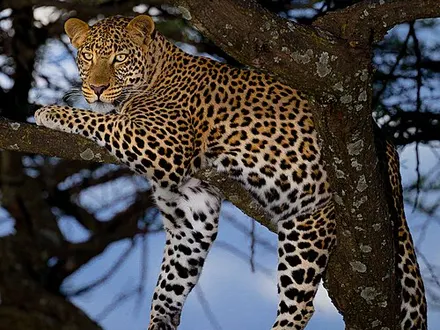
You can tell a cheetah, leopard, and jaguar apart in under two seconds by checking coat spots and facial lines: a Cheetah (Acinonyx jubatus) wears solid black round spots and unmistakable black "tear stripes" down its cheeks; a Leopard (Panthera pardus) wears smaller rose-ringed rosettes with empty golden centers; and a Jaguar (Panthera onca) wears large polygonal rosettes with black dots inside the center atop a stocky, barrel-chested frame.
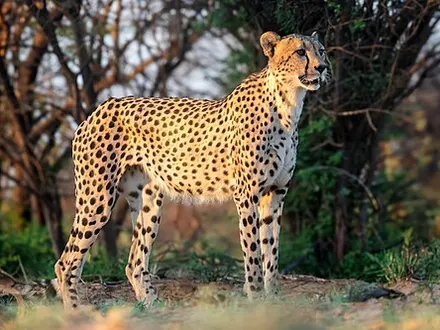
Taxonomically—per the IUCN SSC Cat Specialist Group and Animal Diversity Web—leopards and jaguars are roaring big cats in Subfamily Pantherinae (Genus Panthera), whereas the cheetah sits in Subfamily Felinae (Genus Acinonyx) as sister lineage to North America's Cougar (Puma concolor)!
Complete Cheetah vs. Leopard vs. Jaguar Comparison Chart
| Identification Trait | Cheetah (Acinonyx jubatus) | Leopard (Panthera pardus) | Jaguar (Panthera onca) |
|---|---|---|---|
| Coat Markings | 2,000–3,000 solid black round/oval spots (0 rings) |
Small, dense C/rose rosettes with empty tan centers | Large polygonal rosettes with 1–4 central black dots |
| Face & Head | Small aerodynamic skull + black malar tear stripes | Clean cheeks, medium skull, long counterbalancing tail | Broad, massive jawed skull; short muscular tail |
| Adult Body Mass | 34 – 64 kg (slender greyhound-like sprinter) |
30 – 90 kg (lithe arboreal ambush climber) |
56 – 120+ kg (3rd heaviest cat after tiger & lion) |
| Claws | Semi-retractable blunt cleats + hard grooved paw pads | Fully retractable razor climbing hooks | Fully retractable heavy grappling claws |
| Voice | Cannot roar; purrs continuously & bird-like chirps | Hoarse "wood-sawing" roar (Panthera elastic hyoid) |
Deep guttural grunt-roar; loves swimming rivers |
| Native Range | Africa (+ tiny Critically Endangered population in Iran) | Sub-Saharan Africa & Asia (India, Sri Lanka, Amur Russia) | Americas only (Mexico, Central America, Amazon & Pantanal) |
| IUCN Status | VU (Vulnerable — ~6,500 mature adults left) |
VU (Vulnerable — most widespread big cat) | NT (Near Threatened — apex Neotropical predator) |
Biomechanics: 93 km/h Sprint Cleats vs. Skull-Piercing Bite Quotient
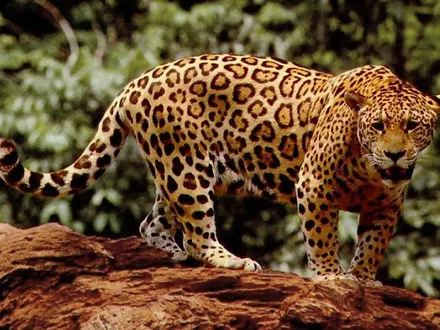
Field telemetry and cranial biomechanics studies highlight how each cat conquered a completely different predatory niche without competing directly:
- Cheetah Deceleration Beats Acceleration: Using custom GPS-IMU collars on wild Botswanan cheetahs, Wilson et al. (2013, Nature, DOI: 10.1038/nature12295) recorded wild hunt speeds reaching
93 km/h(58 mph) (and104.4 km/hon zoo straightaways per Guinness World Records), but discovered their true secret weapon is17 m/s²braking (4×harder than a Polo pony)—letting them pivot sharply behind dodging impalas! - Leopard Vertical Hoisting: A
60 kgAfrican Leopard routinely hauls carcasses weighing80–125 kg(1.5×–2×its own body weight)6 metersvertically into Acacia or Marula forks to keep meals out of reach of lions and spotted hyenas.
- Jaguar Temporal Skull Bite: Comparative carnivore skull mechanics by Wroe, McHenry & Thomason (2005, Proceedings of the Royal Society B) gave Panthera onca the highest mass-adjusted Bite Force Quotient (
BFQ = 137) of any living felid (~6,900 N/1,500 lbfat the carnassials). Unlike lions and leopards that suffocate prey at the throat, jaguars bite straight through caiman skulls and river-turtle carapaces between the ears! Test your rosette eye right now in Zoomed In Animal Quiz.