Animal Taxonomy & Wildlife Identification Field Guides bring together verified zoological comparison tables, acoustic decibel charts, and step-by-step deduction frameworks for players of Guess the Animal Game and students exploring evolutionary biology. Whether you are narrowing branches on the phylogenetic tree, listening to 201 real calls in Guess the Animal Sound, spotting birds in Bird Guessing Game, or eliminating clades in 20 Questions Animal Game, understanding how biologists classify living organisms turns guesswork into crisp scientific deduction.
Complete Field Guide Directory (9 Illustrated Reference Articles)
| Guide Topic & Direct Link | Core Question Answered | Paired Playable Mode |
|---|---|---|
| Alligator vs. Crocodile: 7 Visual Cues | Snout shape, 4th tooth, lingual salt glands & range | Zoomed In Animal Quiz |
| Mammals That Lay Eggs (All 5 Species) | Platypus & 4 echidnas, milk patches & oviparity | 20 Questions Animal Game |
| Turtle vs. Tortoise Identification | Flippers vs. columnar feet, shells & terrapins | Unlimited Survival |
| Frog vs. Toad: Skin, Legs & Spawn | Parotoid glands, jumping legs & Order Anura | Guess the Animal Sound |
| Loudest Animals in the World (dB Chart) | 230 dB whales vs. 140 dB land calls & water physics | Guess the Animal Sound |
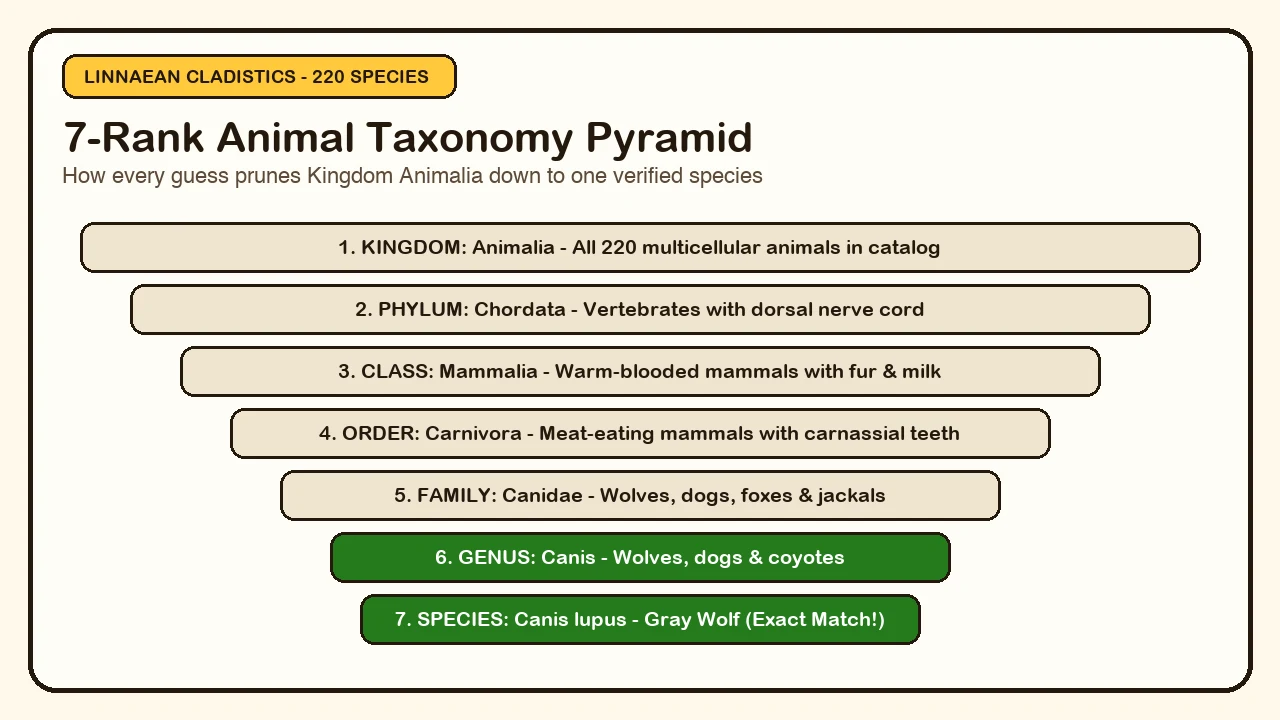
| Animal Taxonomy & Classification Chart | Kingdom → Species & Vertebrate vs. Invertebrate | Daily Guess the Animal |
| Silhouette, Habitat, Diet & Weight Ladder | Reading mass arrows (↑/↓) from 2 g to 140 tons |
Zoomed In Animal Quiz |
| 25 Hardest Taxonomic Curveballs | Living fossils, scaly mammals & misleading names | Unlimited Survival |
| 10-Minute Classroom Biology Bell-Ringers | NGSS smartboard cladogram & dichotomous key relays | 20 Questions Animal Game |
Quick Reference: Major Animal Classes Across Our 365-Species Catalog
- Mammalia (Mammals): Warm-blooded vertebrates with hair or fur and mammary glands—ranging from the 2-gram Etruscan Shrew cousin and egg-laying Platypus up to the 6,000 kg African Bush Elephant and 140,000 kg Blue Whale.
- Aves (Birds — 78 Species): Feathered, hard-shelled-egg-laying theropod dinosaurs—spanning the 2-gram Bee Hummingbird, silent nocturnal Barn Owl, 320 km/h Peregrine Falcon, and flightless Emperor Penguin (playable solo in Bird Guessing Game).
- Reptilia & Amphibia: Ectothermic reptiles (Saltwater Crocodile, Komodo Dragon, Galápagos Giant Tortoise, three-eyed Tuatara) alongside permeable-skinned amphibians (Axolotl, Red-Eyed Tree Frog, Common Toad).
- Chondrichthyes, Actinopterygii & Invertebrates: Cartilaginous sharks and rays (Great White, Giant Oceanic Manta Ray), ray-finned bony fishes (Atlantic Bluefin Tuna, Ocean Sunfish), and spineless marvels (Giant Pacific Octopus, Peacock Mantis Shrimp, Red King Crab, Luna Moth, Water Bear).