Zoomed In Animal Quiz challenges your visual pattern recognition by framing each mystery creature inside a 2.6× macro wildlife photography viewfinder before gradually pulling back to reveal the complete animal. If you enjoy guess the animal picture challenges and wildlife close-up puzzles—but wish wrong guesses gave you real scientific feedback instead of a dead end—this mode combines progressive camera zoom with our full phylogenetic deduction board.
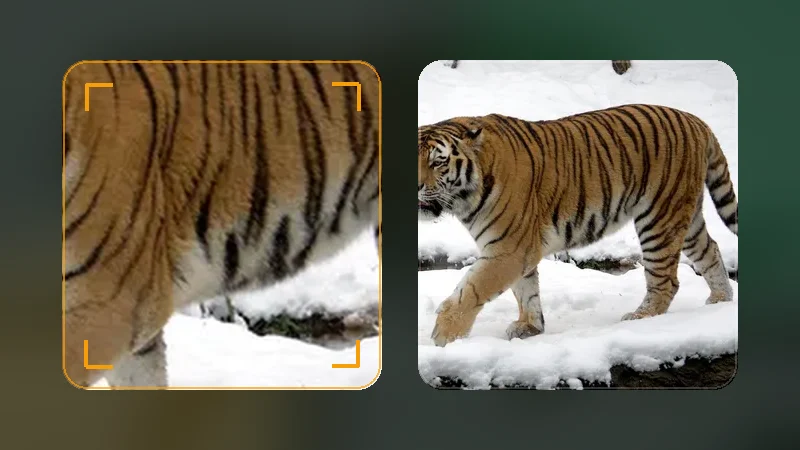
Static magazine close-up quizzes only offer ten fixed photos you memorize once—or reuse the exact same thumbnail in the answer choices so you can match background pixels. Our dynamic macro viewfinder draws from 365 independent clue photographs (separate from the 365 suspect-card portraits!), pairing every visual guess with live Class, Order, Diet, Biome, Range, and Weight (↑/↓) feedback.
How the 5-Stage Macro Lens Escalates
| Aperture Step | Magnification | What You See in the Viewfinder | Max Potential Score |
|---|---|---|---|
| Step 1 (Opening Crop) | 2.6× Macro |
Salient texture focal point—fur rosettes, feather crest, scales, or bill | 100 pts |
| Step 2 | 2.1× Crop |
Head/limb junction + diagnostic coat, skin, or plumage markings | 92 pts |
| Step 3 | 1.65× Mid-Shot |
Torso posture—quadruped, upright biped, swimmer, or winged flyer | 84 pts |
| Step 4 | 1.28× Wide |
Near-complete body profile and surrounding natural habitat | 76 pts |
| Step 5 (Full Frame) | 1.0× Specimen |
Complete uncropped wildlife photograph + unlocked field notes | 68 pts |
Visual Field-Spotter Checklist
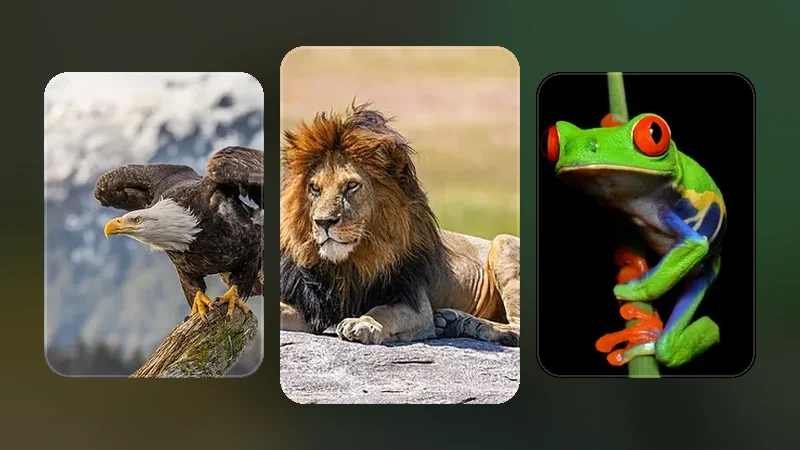
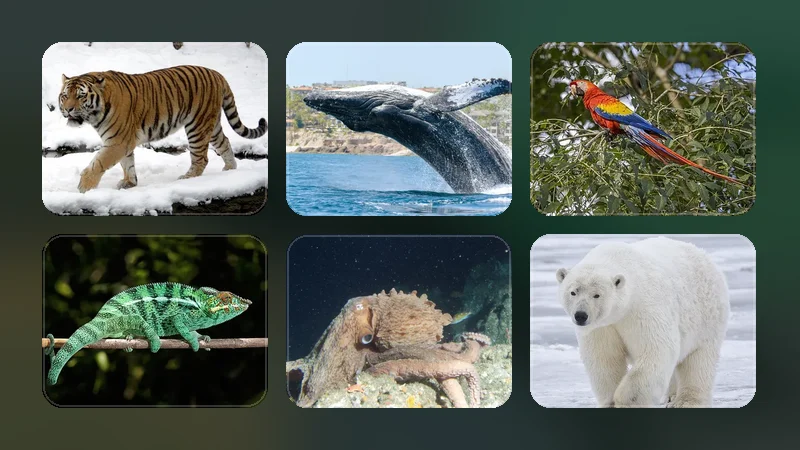
- Separate marine counter-shading from rainforest plumage immediately: Sleek slate-and-silver pelagic skin points strongly toward marine cetaceans (Blue Whale, Bottlenose Dolphin) or cartilaginous sharks (Great White, Hammerhead), whereas iridescent emerald, crimson, or gold textures signal tropical amphibians and canopy birds (Red-Eyed Tree Frog, Scarlet Macaw, Golden Poison Frog).
- Use one strategic guess to zoom out AND test taxonomy at the same time: Instead of clicking Zoom Out passively, submit a real species guess matching the coat or plumage you see! Even if it misses, the lens zooms out automatically and you unlock seven ecological columns without spending a hint penalty.
- Pair visual spotting with our companion modes: Test your ears in Guess the Animal Sound, narrow traits via binary logic in 20 Questions Animal Game, or return to today's Guess the Animal Game daily challenge.
Six Diagnostic Contour Signatures in Wildlife Silhouettes
When you only see 20% of an animal inside the Zoomed In Animal Quiz aperture, focus on structural edges that evolution shaped for locomotion and feeding:
- Swept-Back Dorsal Fin vs. Horizontal Flukes: Both sharks and dolphins show curved dorsal fins, but Orcas, Bottlenose Dolphins, and Humpback Whales terminate in horizontal tail flukes, whereas Great White and Whale Sharks display asymmetrical vertical tail lobes.
- Palmate Antlers vs. Curved Keratin Horns: Broad leaf-like palmate racks immediately identify a northern Moose (Cervidae), whereas twin nasal horns atop a square-lipped snout belong to the White Rhinoceros (Perissodactyla).
- Zygodactyl & Hooked Raptor Bills: A deep, clog-shaped bill in slate gray points straight to East Africa's Shoebill, an oversized bright-orange keel bill signals South America's Toco Toucan, and a compact hooked raptorial beak marks Bald Eagles, Harpy Eagles, or Peregrine Falcons.
- Radial & Eight-Limbed Symmetry: Spotting curved tentacle curls, pincer chelae, or segmented wing veins immediately tells you to skip Phylum Chordata and search our Invertebrate roster (Giant Pacific Octopus, Emperor Scorpion, Peacock Mantis Shrimp, or Orchid Mantis).
- Bipedal Hopper & Long Counterbalance Tail: A steep, muscular hind-leg arch paired with a thick ground-resting tail isolates Australia's Red Kangaroo (Diprotodontia) before you even zoom out to 2.5×.
How Color Palettes Reflect Camouflage vs. Aposematism
Before zooming out a single step, notice the two natural pigment tones rendered along the specimen's edge:
- Counter-Shaded Pelagic & Polar Tones: Marine hunters like the Great White Shark, Orca, and Emperor Penguin exhibit classic Thayer's counter-shading—dark slate dorsums that blend into deep water when viewed from above, paired with pale bellies that match sunlit surface glare when viewed from below.
- Dappled Savanna & Desert Cryptic Ochres: Warm sandy golds and umbers (Fennec Fox, Cheetah, Meerkat, Bactrian Camel, Western Diamondback) match dry grass and dune quartz across Africa, Asia, and North America.
- Aposematic Warning Colors: Bold neon gold, scarlet, tangerine, or electric cyan accents rarely hide—they advertise potent chemical defenses or reef symbiosis, pointing straight toward species like the Golden Poison Frog, Gila Monster, Ocellaris Clownfish, Red-Eyed Tree Frog, or Peacock Mantis Shrimp.
Be the first naturalist to log today's spoiler-free deduction note or request a new animal species.