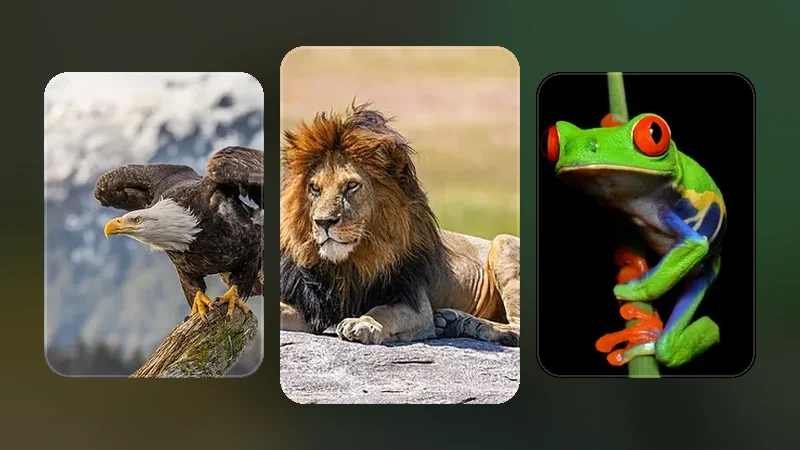
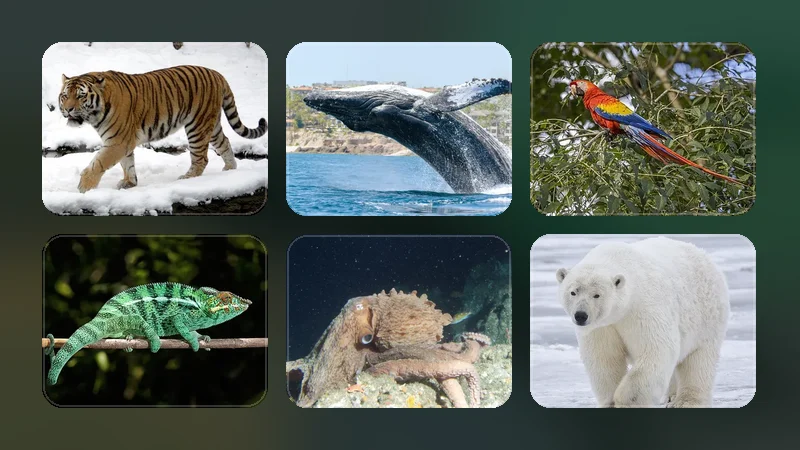
Guess the Animal Sound is an interactive bio-acoustic animal sound guessing game featuring 201 real field-recorded wildlife vocalizations where your ears and taxonomic instincts work together. Press Play Real Animal Call to trigger instant, loudness-normalized wildlife audio paired with a live amplitude waveform—then pick from six photo suspect cards or search all 365 species to lock in your answer in up to five tries.
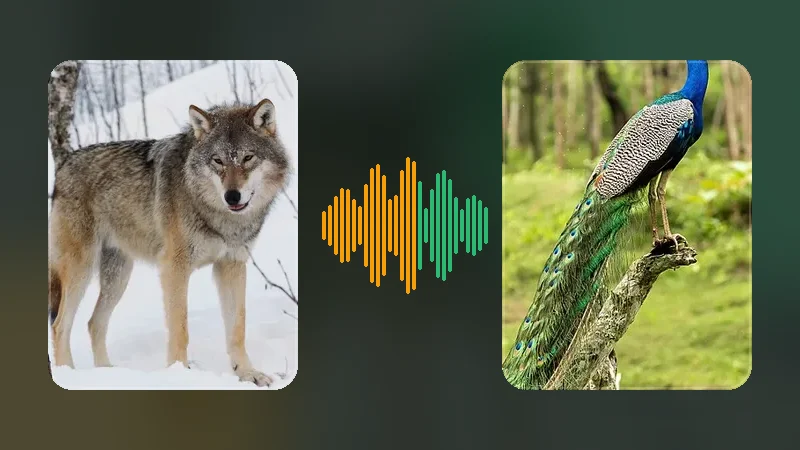
In nature, animals evolve acoustic signals tailored to their body size and surrounding medium. Low-frequency bass waves bend around dense forest trunks and travel hundreds of kilometers through cold ocean water, whereas rapid kilohertz clicks and trills bounce crisply off cave walls, kelp fronds, and savanna grass stems. Understanding those physical rules turns this bio-acoustic studio into an addictive sensory puzzle for kids, families, birders, and biology enthusiasts alike.
Six Signature Bio-Acoustic Call Families to Listen For
| Call Pattern | Typical Pitch Range | Classic Wildlife Examples | Acoustic Clue on Waveform |
|---|---|---|---|
Infrasonic & Pelagic Pulse (WHALE) |
40 – 190 Hz |
Blue Whale, Humpback Whale, Giraffe, Great White | Long, smooth, wide-spaced sinusoidal swells |
Territorial Roar & Bellow (ROAR) |
85 – 260 Hz |
African Lion, Grizzly Bear, Saltwater Croc, Koala, Ostrich | Heavy sawtooth harmonics tapering downward |
Harmonic Pack Howl (HOWL) |
320 – 450 Hz |
Gray Wolf | Sustained rising pitch glide with gentle vibrato |
Nasal / Syrinx Trumpet (TRUMPET) |
290 – 960 Hz |
African Bush Elephant, Emperor Penguin, Flamingo | Brassy mid-band resonance with vibrant overtones |
Biosonar & Rattle (CLICK) |
340 – 2,600 Hz |
Dolphin, Narwhal, Vampire Bat, Rattlesnake, Shoebill | Rapid staccato spikes and high-cadence bursts |
Canopy Chirp & Screech (CHIRP / HISS) |
460 – 2,450 Hz |
Cheetah, Fennec Fox, Bee Hummingbird, King Cobra | Fast frequency modulation or raspy warning hiss |
Four Famous Animal Sound Myths Busted
- Bald Eagles don't scream like movie eagles: Cinema sound designers almost always dub the raspy cry of a Red-Tailed Hawk over bald eagle footage; real bald eagles emit a surprisingly bright, high-pitched piping whistle (
~1,780 Hz)! - Cheetahs cannot roar—they chirp: Unlike lions and tigers in genus Panthera, cheetahs have fixed vocal-box bones that produce piercing bird-like chirps audible to cubs across tall grass, alongside a housecat-style purr.
- King Cobras "growl" at low pitch: While most snakes hiss above
1,000 Hz, tracheal diverticula chambers let an adult King Cobra emit a resonant, dog-like~230 Hzwarning growl. - Peacock Mantis Shrimp snap louder than jet bubbles: Their spring-loaded smasher strike collapses an underwater cavitation bubble with an acoustic pop and microscopic flash of light!
Want visual or deductive challenges too? Switch anytime to our main Daily Guess the Animal Game, zoom out macro contours in Zoomed In Animal Quiz, or explore How to Identify Animals by Silhouette, Diet & Weight.
How Physics Shapes Wildlife Calls: Water vs. Forest vs. Savanna
Bio-acousticians group animal sounds according to the Acoustic Adaptation Hypothesis—the discovery that habitats act like natural audio filters:
- Open Ocean Sound Fixing and Ranging (SOFAR): Sound travels roughly 4.3 times faster in seawater (~1,500 m/s) than in air (~343 m/s). Low-frequency Blue Whale (
42 Hz) and Humpback Whale pulses experience minimal absorption, crossing entire ocean basins, whereas Bottlenose Dolphins and Narwhals fire tight1,900–2,200 Hzclick trains for short-range millimeter biosonar imaging. - Dense Tropical Rainforests: Thick foliage scatters rapid high-frequency buzzes, which is why canopy specialists like the Bornean Orangutan (
160 Hzlong call), Three-Toed Sloth (1,520 Hzpure whistle), and Scarlet Macaw rely on either booming chest resonance or clean tonal whistles that cut cleanly through humid leaves. - Arid Deserts & Grasslands: Ground heat creates upward air refraction during midday, making dusk and dawn (Crepuscular activity) the prime window for African Lions, Gray Wolves, and Common Ostriches to broadcast territorial calls several kilometers across flat terrain.
Reading Oscilloscope Waveforms When Playing Muted or Quietly
Even if you are playing on a commuter train or inside a quiet study hall, the live 260×44 oscilloscope canvas reveals three unmistakable visual clues every time you tap the speaker button:
- Wave Crest Spacing (Wavelength): Wide, rolling crests spaced far apart across the canvas indicate low-frequency sub-bass vocalizations (
40–160 Hz) typical of baleen whales, crocodiles, elephants, hippos, and large bears. Tightly packed vertical oscillations signal1,200–2,600 Hzwhistles, echolocation clicks, and insect stridulation. - Amplitude Envelope: A smooth crescendo peaking near the center of the clip reflects sustained harmonic calls like a Gray Wolf howl or Humpback Whale phrase, whereas sharp sawtooth-edged bursts represent percussive bill-clattering (Shoebill, Wandering Albatross) or keratin tail-rattling (Western Diamondback).
- Combined Taxonomic Elimination: Because every pick among the six candidate cards also populates the 7-Trait Zoological Matrix below, your very first test immediately confirms whether the mystery caller wears feathers, fur, scales, or an exoskeleton.
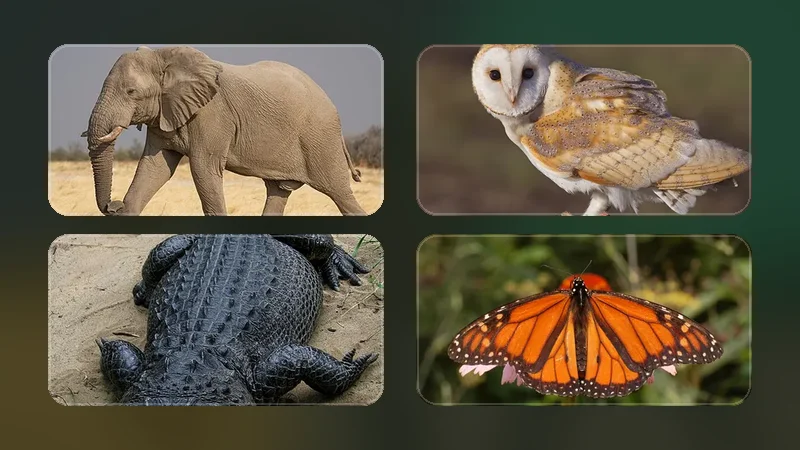
Be the first naturalist to log today's spoiler-free deduction note or request a new animal species.