Learning to identify animals by silhouette, habitat, diet, and weight lets field naturalists recognize wildlife at dusk, through rainforest mist, or from a close-up photograph crop. Inside Zoomed In Animal Quiz and our main Guess the Animal Game, combining visual texture clues with numeric adult body mass—cross-checked against peer-reviewed accounts in the Animal Diversity Web (ADW) and Smithsonian's National Zoo—cuts dozens of possibilities down to a single species in seconds.
Adult Body-Weight Ladder: 6 Mental Anchors From Milligrams to 140 Tons
Volume scales with the cube of length: an animal twice as long and proportionally built weighs roughly eight times as much. Memorizing six milestone weights makes the Weight column (↑ / ↓) deadly accurate:
| Mass Tier | Benchmark Species & Typical Adult Mass | Diagnostic Ecological Clues |
|---|---|---|
| Micro & Tiny (< 0.1 kg) | Bee Hummingbird (2 g), Golden Poison Frog (25 g), Vampire Bat (35 g), Mantis Shrimp (90 g) | High metabolic rate, nectar/insect diet, or reef/canopy micro-niches |
| Small (0.5 – 10 kg) | Fennec Fox (1.3 kg), Platypus (1.7 kg), Bald Eagle (4.8 kg), Red Fox (7 kg), Koala (10 kg) | Flyers, burrowers, arboreal climbers, and specialized nocturnal hunters |
| Lower-Medium (12 – 65 kg) | Honey Badger (12 kg), Sea Otter (28 kg), Emperor Penguin (32 kg), Gray Wolf (42 kg), Cheetah (52 kg) | Pack predators, kelp-forest divers, and agile savanna runners |
| Upper-Medium (65 – 300 kg) | Red Kangaroo (68 kg), Komodo Dragon (75 kg), Giant Panda (105 kg), Ostrich (115 kg), African Lion (190 kg) | Apex ambush felids, giant flightless birds, and bamboo/island specialists |
| Large (300 – 1,500 kg) | Plains Zebra (320 kg), Polar Bear (450 kg), Saltwater Crocodile (650 kg), Great White Shark (1,100 kg), Giraffe (1,100 kg) | Polar megacarnivores, pelagic sharks, and tall ungulate browsers |
| Megafauna (1,500 – 140,000 kg) | Hippopotamus (1,600 kg), White Rhino (2,100 kg), Orca (5,400 kg), African Elephant (6,000 kg), Whale Shark (12,000 kg), Blue Whale (140,000 kg) | Thick-skinned pachyderms and buoyancy-supported ocean giants |
Reading Acoustic Pitch Bands & Matching Biomes
- Infrasonic & Deep Bass (18 – 180 Hz): Blue Whale, Giraffe, Saltwater Crocodile, African Lion, and Koala (read our Loudest Animals Decibel Chart for full measurements).
- Mid-Band Trumpets & Howls (250 – 650 Hz): African Bush Elephant, Gray Wolf, Emperor Penguin, and Greater Flamingo.
- High-Frequency Clicks & Chirps (1,100 – 2,600 Hz+): Cheetah chirps, Bottlenose Dolphin biosonar clicks, Western Diamondback rattles, and Bee Hummingbird trills.
Diagnostic Contour Cues: Ears, Pupils, Feet & Tails
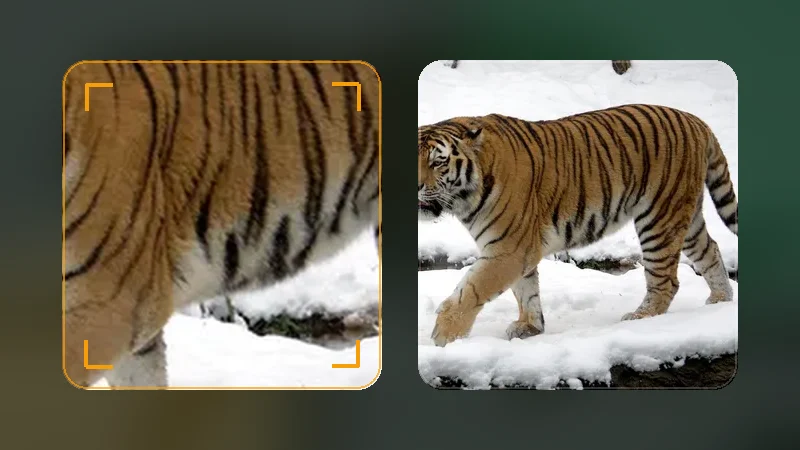
When inspecting a 2.6× macro photograph in Zoomed In Animal Quiz before zooming out, scan four anatomical structures documented in field guides from the Cornell Lab of Ornithology and Animal Diversity Web:
- Pupil Geometry & Activity Rhythm: Vertical slit pupils (Red Fox, Western Diamondback Rattlesnake, small ambush felids) allow a 135-to-300-fold change in light aperture for crepuscular and nocturnal ambush hunting. Horizontal rectangular pupils (Alpine Ibex, Plains Zebra, Hippopotamus, Common Octopus) maintain panoramic horizon focus while grazing or scanning open terrain, whereas large round pupils characterize tall diurnal pursuit hunters (Cheetah, Gray Wolf, Bald Eagle).
- Pinnae (External Ear) Proportions: Under Allen's ecogeographical rule, desert mammals such as the Fennec Fox (15 cm ears on a 1.3 kg body) and African Bush Elephant radiate body heat through heavily vascularized ear flaps, whereas high-Arctic relatives like the Arctic Fox and Polar Bear minimize ear surface area to prevent frostbite.
- Integument Micro-Texture: Overlapping beta-keratin scutes signal reptiles (Reptilia) or pangolin scales (Pholidota); barbed interlocking vanes indicate bird plumage (Aves); smooth glandular skin lacking scales or hair points to amphibians (Amphibia) or marine cetaceans; and segmented chitin plates with jointed setae identify arthropods (Arthropoda).
- Foot & Digit Symmetry: Two weight-bearing hooves (cloven hooves) place a mammal inside even-toed ungulates (Artiodactyla), a single central hoof identifies odd-toed Perissodactyla (Plains Zebra, Malayan Tapir), and zygodactyl toes (two forward, two backward) narrow birds directly to parrots, woodpeckers, toucans, and owls in Bird Guessing Game.