The quickest way to spot the difference between an alligator and a crocodile is by looking at the snout, closed jaw, and habitat: alligators have a wide, shovel-like U-shaped snout, hide their lower teeth when their jaws close, wear dark charcoal-black armor, and stick to freshwater swamps; crocodiles have a pointed V-shaped snout, display a prominent exposed 4th lower tooth when their mouth is shut, show olive-tan hides, and possess working tongue salt glands that let them thrive in saltwater estuaries.
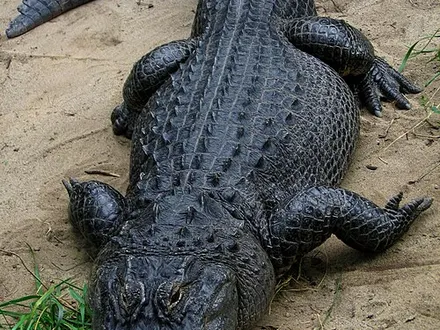
In Linnaean taxonomy—verified via ITIS and the Florida Museum Crocodilian Biology Database—both belong to Order Crocodilia, which split roughly 80 to 90 million years ago during the Late Cretaceous into separate families: Family Alligatoridae (true alligators and caimans) and Family Crocodylidae (true crocodiles).
7-Point Alligator vs. Crocodile Comparison Table
| Diagnostic Trait | Alligator (Family Alligatoridae) | Crocodile (Family Crocodylidae) |
|---|---|---|
| 1. Snout Geometry | Broad, rounded U-shape built for crushing turtle shells & snails | Narrower, tapered V-shape built for seizing fish & mammals |
| 2. Teeth With Jaws Closed | Upper jaw overlaps lower jaw; bottom teeth hidden inside sockets | Upper jaw has a notch; large 4th lower tooth sticks out visibly |
| 3. Hide Coloration | Dark slate gray to nearly jet black (blends into tannin swamp water) | Lighter olive green, khaki, or muddy tan (blends into sandy banks) |
| 4. Saltwater Tolerance | Freshwater specialist (vestigial, inactive lingual salt glands) | Brackish & marine capable (active salt-excreting lingual glands) |
| 5. Skin Pressure Sensors (ISOs) | Tiny black sensory dots only around the jaws and face | Sensory dome receptors on almost every body and belly scale |
| 6. Typical Adult Size | American Alligator: ~240–450 kg (3.0 – 4.2 m) |
Saltwater Crocodile: ~650–1,000+ kg (4.3 – 6.1 m) |
| 7. Geographic Range | Only US Southeast & Eastern China (2 true alligator species; caimans in Latin America) | Africa, Asia, Australia & Tropical Americas (~16 true crocodile species) |
Close-Up Anatomy: Jaw Occlusion & Sensory Dots
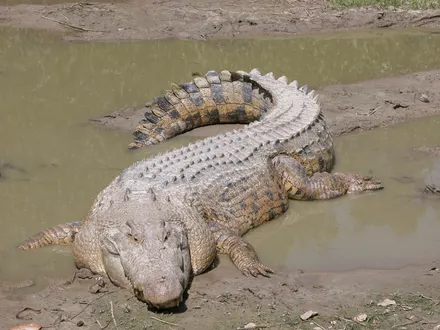
When playing Zoomed In Animal Quiz at 2.6× magnification, you often see a tight crop of scaly jaws before the full body appears. Look for two unmistakable microscopic clues:
- Interlocking vs. Overbite Dentition: In an American Alligator or Black Caiman, the upper maxilla is wider than the mandible, so lower teeth fit neatly into hidden pits inside the upper gums. In a Nile Crocodile or Saltwater Crocodile, upper and lower teeth interdigitate like a zipper, and the oversized fourth mandibular tooth rests in an external groove on the outside of the snout.
- Integumentary Sensory Organs (ISOs): Both lineages carry pinhead-sized black dome receptors more sensitive to water ripples than human fingertips. However, alligators restrict ISOs to the margins of their jaws, whereas true crocodiles carry a small black sensory pore near the rear edge of nearly every ventral scale on their body.
Where Caimans & Gharials Fit in Order Crocodilia
Order Crocodilia actually contains three living families, all represented in our 365-Species Unlimited Mode:
- Alligatoridae: Includes the American Alligator, critically endangered Chinese Alligator, and Central/South American Caimans (such as the 350 kg Amazonian Black Caiman).
- Crocodylidae: Includes the Nile Crocodile (Africa) and Saltwater Crocodile (Asia & Oceania).
- Gavialidae: Represented by India's critically endangered Gharial, whose ultra-slender, tweezer-like snout studded with 100+ needle teeth specializes strictly in sweeping sideways after river fish.
Bite Force, Cold Tolerance & Everglades Coexistence
Biomechanical bite-force trials led by Gregory Erickson and colleagues recorded adult Saltwater Crocodiles clamping at 16,460 Newtons (3,700 lbf)—the highest directly measured bite force of any living animal—while large American Alligators reached 9,452–13,172 N (2,125–2,960 lbf). Despite that jaw closing power, the muscles that open a crocodilian's mouth are surprisingly weak, evolved mainly for lifting the upper jaw in water.
Thermoregulation also separates the two families in North America: according to the U.S. National Park Service Everglades Wildlife Guide, American Alligators range as far north as coastal North Carolina by entering brumation—resting in submerged mud while keeping their nostrils above surface ice in an "icing response"—whereas American Crocodiles (Crocodylus acutus) are cold-sensitive tropical specialists restricted in the United States to warm mangrove lagoons at the southern tip of Florida.