The loudest animal in the world overall is the Sperm Whale (Physeter macrocephalus), whose focused biosonar clicks peak at 230 to 236 dB (underwater) while hunting giant squid in pitch-black ocean trenches, followed closely by the Blue Whale (188 dB low-frequency pulses). On land, the Mantled & Black Howler Monkeys (Genus Alouatta) claim the crown as the loudest terrestrial animals at up to 140 dB, ahead of the White Bellbird (125 dB), African Lion (114 dB), and Periodical Cicada (106–120 dB).
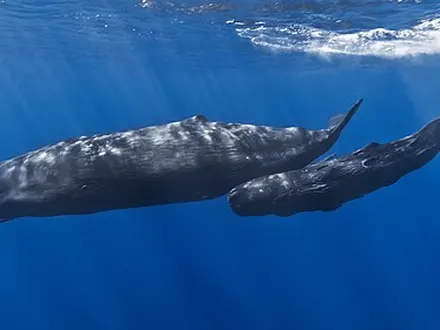
You can audition real field recordings of nearly every species on this chart directly inside Guess the Animal Sound! Below is the complete zoological ranking compiled from NOAA Ocean Acoustics, Smithsonian National Zoo, and peer-reviewed bio-acoustic literature.
Top 12 Loudest Animals in the World (Verified Decibel Table)
Crucial Physics Note: Underwater decibels use a reference pressure of
1 μPain dense seawater, whereas airborne decibels use20 μPain air. To compare intensity fairly on the same airborne scale, subtract~61.5 dBfrom any underwater measurement (shown in the third column!).
| Rank & Species | Peak Measured Level | Equivalent Airborne Scale (re 20 μPa) |
Acoustic Mechanism & Purpose |
|---|---|---|---|
| 1. Sperm Whale (Physeter macrocephalus) | 230 – 236 dB (water) |
~169 – 174 dB |
Spermaceti organ & phonic lips focus directional biosonar clicks |
| 2. Snapping / Mantis Shrimp (Cavitation) | 210 – 218 dB (water) |
~149 – 156 dB |
Vapor cavitation bubble collapse stuns reef prey at point-blank range |
| 3. Blue Whale (Balaenoptera musculus) | 188 dB (water) |
~126.5 dB |
14–42 Hz infrasonic pulses cross hundreds of ocean kilometers |
| 4. Humpback Whale (Megaptera novaeangliae) | 180 dB (water) |
~118.5 dB |
Complex multi-octave breeding songs lasting 10–20 minutes |
| 5. Howler Monkey (Alouatta palliata) | 128 – 140 dB (air) |
128 – 140 dB |
Hollow, enlarged hyoid throat bone acts as a natural megaphone |
| 6. Greater Bulldog Bat (Noctilio leporinus) | 137 – 140 dB (air) |
137 – 140 dB |
Ultrasonic (50+ kHz) biosonar pings above human hearing range |
| 7. White Bellbird (Procnias albus) | 125.4 dB (air) |
125.4 dB |
Loudest recorded bird song on Earth (Amazonian canopy) |
| 8. African Bush Elephant (Loxodonta africana) | 117 dB (air) |
117 dB |
Nasal trumpets + 15 Hz seismic rumbles felt through foot pads |
| 9. African Lion & Tiger (Genus Panthera) | 114 dB (air) |
114 dB |
Elastic, flat square vocal folds broadcast pride territory 8 km away |
| 10. Gray Wolf (Canis lupus) | 108 – 115 dB (air) |
108 – 115 dB |
Harmonic pack howls carry up to 10–16 km across open tundra |
| 11. Hippopotamus (Hippopotamus amphibius) | 115 dB (air) |
115 dB |
Amphibious wheeze-honk transmitted simultaneously in air & river water |
| 12. Cicada (Magicicada / Brevisana) | 106 – 120 dB (air) |
106 – 120 dB |
Ribbed abdominal tymbal membranes buckling 300–400 times/sec |
How Land Champions Build Biological Megaphones
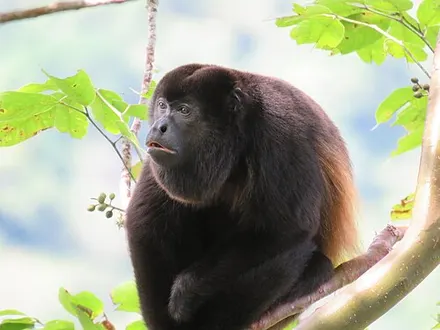
Why doesn't a 6.5 kg Mantled Howler Monkey blow out its own eardrums or burn through all its energy? Evolution solved acoustic efficiency through resonance chambers:
- The Howler Hyoid Cup: Male howler monkeys possess an inflatable, apple-sized bony shell (hyoid apparatus) at the top of the windpipe—roughly 20 times larger proportionally than a human's—turning muscular air pressure into low-frequency booming waves (
300–800 Hz) that bend cleanly around rainforest tree trunks. - Tymbal Buckling in Cicadas: Insects lack lungs and vocal cords; male Periodical Cicadas flex paired ribbed membranes (tymbals) on their hollow abdomen, turning their entire body cavity into a miniature snare drum!
- Test Your Ears Right Now: Can you tell a Sperm Whale click train apart from a Mantled Howler Monkey roar, a Laughing Kookaburra, or a Periodical Cicada? Jump straight into Guess the Animal Sound (201 Real Calls) and try a 5-guess round!