An animal taxonomy chart—also called a biological animal classification chart—organizes millions of living creatures into a nested evolutionary family tree moving from broad body-plan blueprints down to a single unique species. In Guess the Animal Game, every guess lights up the deepest taxonomic rank your chosen creature shares with the mystery species, turning Carl Linnaeus's hierarchy and modern DNA cladistics—standardized in public repositories such as the NCBI Taxonomy Database and the Integrated Taxonomic Information System (ITIS)—into an interactive detective board.
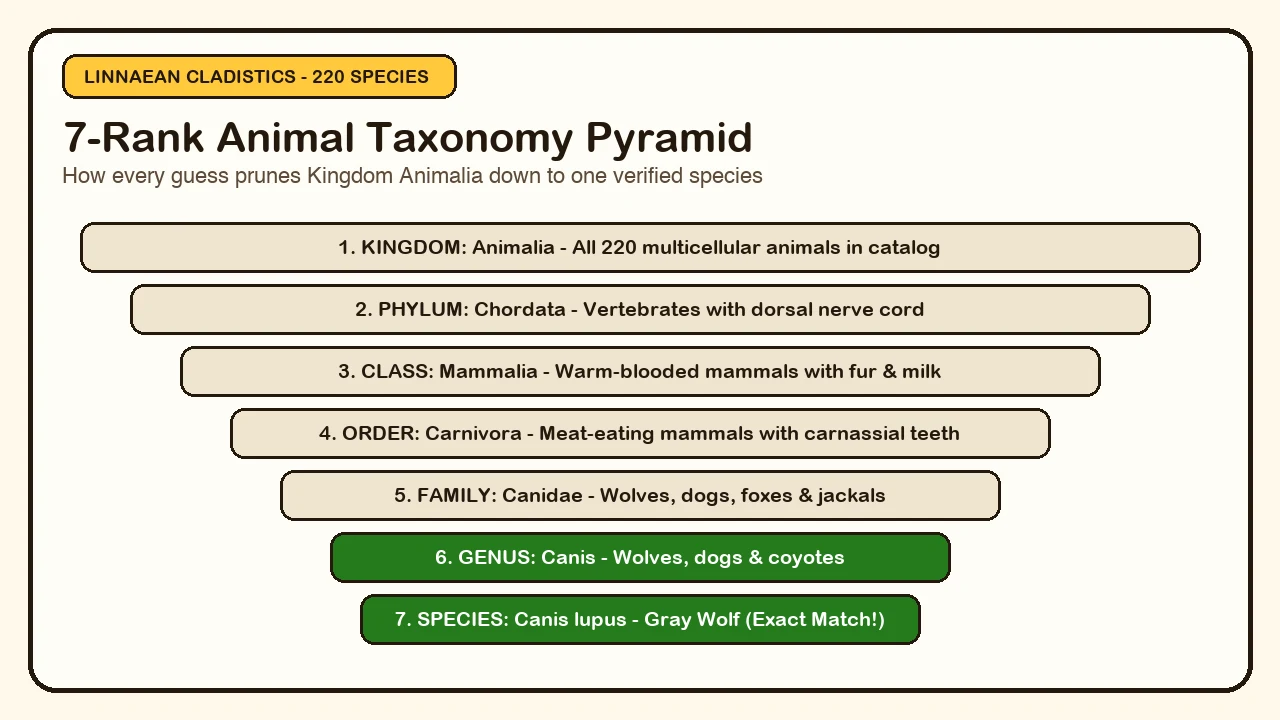
The 7 Ranks From Kingdom to Species (Wolf vs. Lion vs. Octopus)
Every animal in our 365-species database sits at the tip of seven nested ranks. Compare how Gray Wolf (Canis lupus) and African Lion (Panthera leo) travel together down the first four levels before splitting at Family:
| Taxonomic Rank | Gray Wolf (Canis lupus) | African Lion (Panthera leo) | Giant Pacific Octopus (Enteroctopus dofleini) |
|---|---|---|---|
| 1. Kingdom | Animalia (All multicellular animals) | Animalia | Animalia |
| 2. Phylum | Chordata (Vertebrates & chordates) | Chordata | Mollusca (Diverges at Phylum!) |
| 3. Class | Mammalia (Warm-blooded, fur, milk) | Mammalia | Cephalopoda |
| 4. Order | Carnivora (Shared branch!) | Carnivora (Shared branch!) | Octopoda |
| 5. Family | Canidae (Dogs, wolves, foxes) | Felidae (Cats) | Enteroctopodidae |
| 6. Genus | Canis | Panthera | Enteroctopus |
| 7. Species | Canis lupus | Panthera leo | Enteroctopus dofleini |
Animal Classification Chart: Vertebrate vs. Invertebrate Split
The single most important first-turn split in both zoology and 20 Questions Animal Game is vertebrate vs. invertebrate anatomy:
| Feature | Vertebrates (Phylum Chordata) | Invertebrates (30+ Non-Chordate Phyla) |
|---|---|---|
| Internal Skeleton | Endoskeleton with a jointed vertebral column & cranium | No backbone; chitin exoskeleton (Arthropoda), shell/mantle (Mollusca), or hydrostatic body |
| Share of Animal Species | ~3% of described animal species (~70,000+ species) | ~97% of all described animal species (>1.3 million species) |
| Major Classes in Game | Mammalia, Aves, Reptilia, Amphibia, Actinopterygii, Chondrichthyes | Insecta, Arachnida, Malacostraca, Cephalopoda, Gastropoda, Asteroidea, Hydrozoa |
| Body Size Ceiling | Up to 140,000 kg (Blue Whale) via internal bone/buoyancy support | Up to 495 kg (Colossal Squid) in deep-ocean water; small on land due to molting limits |
Five Surprising DNA Splits Every Quiz Player Should Know
- Whales & Dolphins Belong to Artiodactyla (Even-Toed Ungulates): Guessing Giraffe or Hippopotamus unlocks Order Artiodactyla—keep marine cetaceans like Blue Whale and Orca in mind if Biome points to oceans!
- Spotted Hyenas Are Closer to Cats Than Dogs: Hyaenidae sits inside suborder Feliformia alongside cats, mongooses (Meerkat), and civets (Binturong).
- Falcons Split From Hawks & Eagles: Peregrine Falcons (Falconiformes) are genetically closer to parrots and songbirds than to Bald Eagles (Accipitriformes)—test this live in Bird Guessing Game.
- Manatees Share Ancient Roots With Elephants & Aardvarks: Within superorder Afrotheria, West Indian Manatees, African Elephants, and Aardvarks share an ancient African ancestor.
- Horseshoe Crabs Are Closer to Spiders Than Crabs: Atlantic Horseshoe Crabs sit in Subphylum Chelicerata with arachnids rather than true decapod crustaceans.
4-Turn Taxonomic Funnel Strategy (Worked Example)
Instead of guessing random animals from the same habitat, open each round of Guess the Animal Game with a diverse taxonomic probe that tests Phylum, Class, Biome, Diet, and Adult Mass simultaneously:
- Turn 1 — Broad Vertebrate Opener (Gray Wolf, 42 kg): Tests Phylum Chordata, Class Mammalia, Order Carnivora, terrestrial forest/tundra biomes, and mid-size predator mass. Suppose the board reveals Phylum: Chordata (
✓), Class: Aves (✗on Mammalia), Diet: Carnivore (✓), and Weight:↓(< 42 kg). - Turn 2 — Class & Order Split (Bald Eagle, 4.8 kg): Probes Class Aves and raptor orders while cutting weight by nearly tenfold. If Class: Aves lights green (
✓), Biome: Coastal / Marine turns green, and Weight:↑(> 4.8 kg) appears, you know the target is a heavy fish-eating seabird between 5 kg and 42 kg. - Turn 3 — Flightless vs. Pelagic Seabird Check (Emperor Penguin, 32 kg): Confirms Order Sphenisciformes (
✓) or narrows down to heavy flying seabirds like the Wandering Albatross (9 kg), locking in the exact species by Turn 4!
According to catalog records in the Catalogue of Life and ITIS, mammals (Mammalia, ~6,600 described species) and birds (Aves, ~11,000 species) divide cleanly into 27 to 44 living orders—making Order-level elimination the fastest mathematical shortcut across all 365 wildlife profiles.