Biology bell-ringer games turn the first five to ten minutes of life-science class from passive worksheet copying into active scientific hypothesis testing aligned with the Next Generation Science Standards (NGSS) and biodiversity profiles from Animal Diversity Web. Because Guess the Animal Game and 20 Questions Animal Game run instantly in any browser with zero logins, teachers can project a single mystery organism on the classroom smartboard and challenge lab tables to justify every guess using real taxonomic and ecological vocabulary.
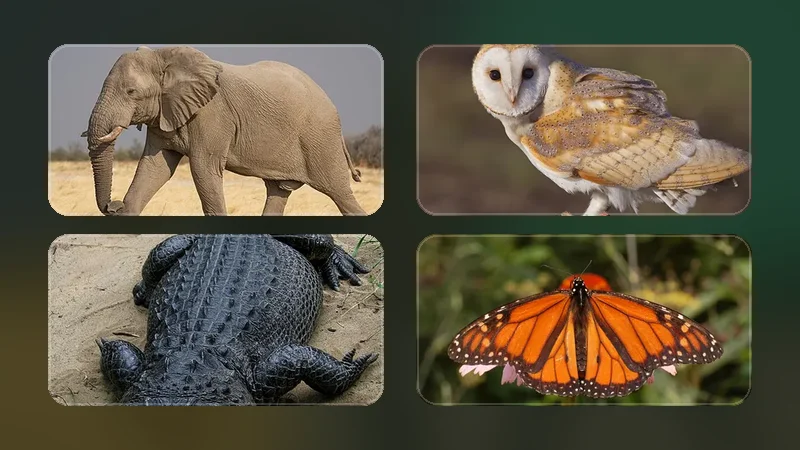
Three Ready-to-Run 10-Minute Classroom Formats
1. Whole-Class Smartboard Cladogram Relay (5–7 Minutes)
Open the Daily Guess the Animal homepage at the start of period. Divide the room into four lab groups and give each table 30 seconds to propose the next species guess—requiring the spokesperson to state which taxonomic rank or ecological column their guess tests.
2. Dichotomous Key Efficiency Challenge in 20 Questions Mode (8 Minutes)
Launch 20 Questions Animal Game and point out the live Matching Animals Left counter (365 at round start). Ask students which single Yes/No biological question cuts the candidate pool closest to 50/50—reinforcing the exact logic behind dichotomous identification keys.
3. Convergent Evolution vs. Shared Ancestry Exit Ticket (10 Minutes)
Pair Animal Guessing Game Unlimited with our Animal Taxonomy Chart Guide. Challenge pairs of students to find two animals that share the same Diet and Biome (such as Bottlenose Dolphin and Great Hammerhead Shark) while sitting in different Classes, then explain convergent evolution versus homologous ancestry.
Grade-Band Alignment & Classroom Accessibility
| Grade Band | Core Biology Concept Reinforced | Recommended Mode & Setup |
|---|---|---|
| Grades 5–6 | Vertebrate vs. invertebrate traits, food webs & biomes | Guess the Animal Sound & Zoomed In Animal Quiz |
| Grades 7–8 | Dichotomous keys, structural adaptations & Linnaean ranks | 20 Questions Animal Game team voting |
| Grades 9–12 / AP Bio | Phylogenetic trees (cladograms), common ancestors & IUCN status | Daily Guess the Animal + shared ?c= custom lab challenges |
Minute-by-Minute Teacher Script & Question Stem Bank
To keep a 10-minute bell-ringer crisp without spilling into main lab time, science departments using Next Generation Science Standards (NGSS) life-science units (MS-LS4-2, HS-LS4-1) typically follow a three-step timer:
- Minutes 0:00 – 2:00 (Diagnostic Probe): Project the game board before taking attendance. Assign Table 1 to pick an opening organism and state its Phylum and Class aloud (for example: "We choose American Bullfrog to test Phylum Chordata, Class Amphibia, freshwater wetlands, and insectivore/carnivore diet").
- Minutes 2:00 – 6:30 (Evidence-Based Elimination): Require every subsequent table to cite at least two data columns from the previous row before naming their candidate ("Because Chordata stayed green while Amphibia turned gray and Weight pointed upward above 0.55 kg, we eliminate invertebrates and small frogs and test Reptilia with Green Sea Turtle").
- Minutes 6:30 – 9:30 (Adaptation & Conservation Debrief): Once the mystery species unlocks—complete with verified scientific binomial, ITIS rank path, and IUCN Red List conservation code (LC, NT, VU, EN, CR)—ask students one quick notebook synthesis prompt:
- Homology vs. Analogy: "Which trait on the board reflects shared ancestry (homologous), and which evolved independently for the habitat (analogous)?"
- Binary Information Gain: "In 20 Questions Animal Game, why did asking 'Is it a vertebrate?' eliminate fewer species than asking 'Is it a mammal?' inside our 365-species catalog?"
- Trophic Mass Scaling: "How does the adult mass of today's organism relate to its diet and thermoregulation (endotherm vs. ectotherm)?"
Zero-PII School Network & Chromebook Compatibility
Every game mode on Guess The Animal executes locally over standard HTTPS with zero student sign-in forms, zero chat rooms, zero third-party behavioral ad trackers, and printable/linkable reference tables across all nine Wildlife Field Guides—making it safe for district-managed Chromebooks, iPads, and interactive classroom panels.