The quickest way to understand bison vs. buffalo is the classic "Three H's" rule: Home, Hump, and Horns. True bison—the American Bison (Bison bison, ITIS TSN 180706) and European Bison (Bison bonasus, ITIS TSN 183836)—live natively in North America and Europe, stand behind a towering muscular shoulder hump, grow a thick shaggy cape and chin beard, and wear short, sharp, upward-curving horns. True buffalo—the Asian Water Buffalo (Bubalus bubalis, ITIS TSN 552476) and African Cape Buffalo (Syncerus caffer, ITIS TSN 183847)—live natively in Asia and Africa, have a level back with no steep shoulder hump, carry sleek, sparse hair with no beard, and display massive sweeping or forehead-fused horns.
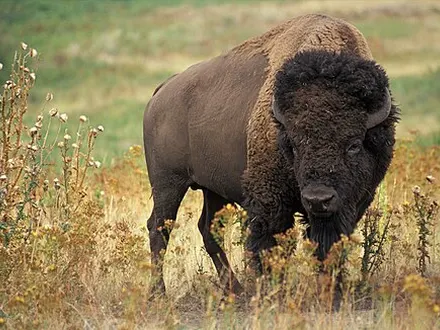
All four animals share Class Mammalia, Order Artiodactyla, Family Bovidae (ITIS TSN 180704), making them distant even-toed ungulate cousins alongside domestic cattle and yaks. Yet according to Smithsonian's National Zoo and the U.S. National Park Service, they split into distinct evolutionary genera millions of years ago—meaning no native true buffalo has ever roamed wild in North America.
Complete Bison vs. Buffalo Comparison Table
Compare the diagnostic anatomical, geographic, and ecological traits of the American Bison against both living true buffalo lineages using verified records from ITIS, Smithsonian's National Zoo, and Animal Diversity Web:
| Diagnostic Trait | American Bison (Bison bison) | Asian Water Buffalo (Bubalus bubalis) | African / Cape Buffalo (Syncerus caffer) |
|---|---|---|---|
| ITIS Taxonomic ID | Genus Bison (TSN 180706) |
Genus Bubalus (TSN 552476) |
Genus Syncerus (TSN 183847) |
| Native Continent | North America (European bison in Europe) | South & Southeast Asia | Sub-Saharan Africa |
| Shoulder Hump | Very tall, steep muscular hump (~1.5 m high) |
None (relatively flat, level topline) | None (stocky, muscular, even back) |
| Thoracic Rib Pairs | 14 pairs (tall neural spines anchor neck) |
13 pairs (standard bovid ribcage) |
13 pairs (heavy barrel ribcage) |
| Horn Geometry | Short, black, sharp upward hooks | Widest spread of any bovid; sweeping crescents, bases wide apart | Thick downward-then-upward curves; bases fuse into a forehead boss (up to 130 cm) |
| Coat & Chin Beard | Dense, shaggy dark winter cape + bull beard | Sparse, ashy-gray to black hair; no beard | Short, dark brown to black hair; no beard |
| Adult Body Mass | 318 – 900 kg (ADW); bulls 816 – 1,088 kg (Smithsonian; game avg 750 kg) |
Wild males to 1,200 kg, females to 800 kg; domestic 250 – 550 kg (game avg 800 kg) |
Savanna bulls >835 kg, cows to 500 kg (S. c. caffer) |
| Primary Biome | Cold prairies, sagebrush & plains (Terrestrial) | Rivers, floodplains & swamps (Semi-Aquatic) | Savannas, woodlands & marshes (Terrestrial) |
| Wild Lifespan | 15 – 20 years (game: 18 yr; captivity to 40) |
Up to 25 years (game: 25 yr) |
Up to 22 years (average ~11 yr in wild) |
| Playable in Catalog? | Yes (real photo + recorded call · NT) |
Yes (real photo + recorded call · LC domestic) |
Reference species (syncerus lineage) |
Skeletal Biomechanics: Why Bison Built a 14-Rib Snowplow
The dramatic silhouette difference between a bison and a water buffalo starts underneath the fur. Whereas domestic cattle (Bos taurus) and true Old World buffalo have 13 pairs of ribs, both American and European bison carry 14 pairs of ribs attached to 14 thoracic vertebrae. The upward projections (dorsal spinous processes) on the anterior thoracic vertebrae of an American bison extend far higher than those of cattle or buffalo, forming the rigid bony scaffold inside the shoulder hump.
Massive rhomboideus and splenius neck muscles, reinforced by a thick elastic nuchal ligament, anchor to those tall spines and run straight to the back of the bison's oversized skull. During harsh winters on the northern Great Plains and in Yellowstone National Park—the only place in the United States where wild bison have lived continuously since prehistoric times—bison do not paw snow with their hooves like horses or elk. Instead, they swing their broad heads horizontally like living snowplows through chest-deep drifts to uncover dormant sedges and grasses beneath the crust.
That same winter specialization explains the bison's famous seasonal coat. According to Smithsonian's National Zoo, thick dark wool insulates the head, neck, shoulders, and forelegs so effectively that falling snow can accumulate on a bison's back without melting from escaping body heat. Come spring and early summer, bison rub against boulders and tree trunks, shedding matted patches of winter wool while adult bulls keep their prominent dark chin beards.
Horn Architecture & Habitat: Asian Water Buffalo vs. African Cape Buffalo
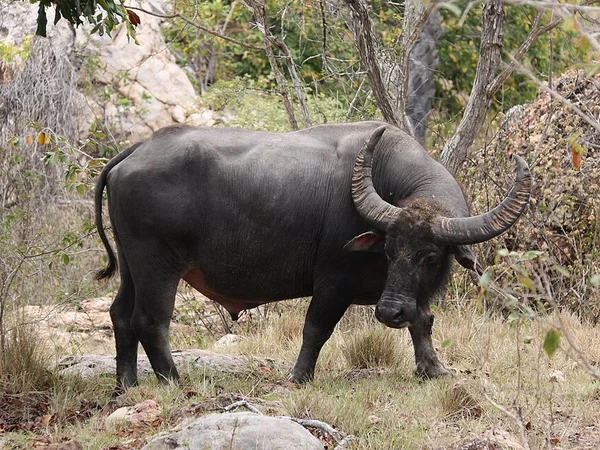
Because Asian Water Buffalo and African Cape Buffalo evolved in warm tropical wetlands and savannas rather than subzero blizzards, they solved completely different survival problems:
- Asian Water Buffalo (Bubalus bubalis): Built for flooded river deltas, marshes, and rice paddies across Asia. Per Animal Diversity Web, water buffalo walk on broad, flexible, splayed hooves that act like mud snowshoes so an
800 kgadult does not sink into river silt. Because their sparse gray-black skin carries few sweat glands, they wallow daily in mud and deep rivers to shed heat and repel biting flies. Their heavy, ringed, crescent-shaped horns sit wide apart at the base and produce the widest horn spread of any living bovid. In conservation taxonomy, the domesticated lineage (Bubalus bubalis) is widespread and listed as Least Concern (LC) in our catalog, whereas the remaining wild Asian water buffalo (Bubalus arnee) is critically pressured by habitat loss and hybridization. - African / Cape Buffalo (Syncerus caffer): Native across Sub-Saharan Africa, from massive
835+ kgsavanna bulls (S. c. caffer) standing140–160 cmat the shoulder down to smaller reddish forest buffalo (S. c. nanus,105 cmtall). Unlike water buffalo, whose horn bases remain widely separated, a mature African buffalo bull's smooth, unridged horns grow thick at the midline until they weld together into a solid cranial shield called a boss, capable of absorbing high-speed rival clashes and fending off lions, per Animal Diversity Web.
How North America's Bison Got Called "Buffalo"
If North American bison are biologically distinct from Old World buffalo, why do U.S. place names, coins, songs, and wildlife stories still say "buffalo"? Linguists and historians at the National Park Service and Smithsonian's National Zoo trace the mix-up to 17th-century European fur trappers and explorers.
French voyageurs encountering vast prairie herds called the animals les boeufs (meaning oxen or beef cattle), a word that drifted in pronunciation to buffle and merged with the English term buffalo, which English speakers already used for African and Asian wild oxen. Biologists use bison to prevent taxonomic confusion with Bubalus and Syncerus, while many Plains Indigenous Nations continue using buffalo for its deep cultural, linguistic, and historical roots. In our game search bar, typing either bison or buffalo finds American Bison cleanly without penalizing everyday speech.
European Bison, Domestic Cattle & Yaks in Family Bovidae
Wild bison also live in Europe: the European Bison or Wisent (Bison bonasus, ITIS TSN 183836) survived near-extinction in the 1920s through captive breeding and now roams forests in Poland, Belarus, and neighboring nations. Compared with Bison bison, it stands slightly taller with longer legs, a leaner forequarter mane, and a diet richer in woody browse.
Inside our 365-species catalog, four heavy Bovidae species often appear together on the same deck:
- American Bison (
750 kg, North America, Savanna & Grassland,NT): Humped silhouette, shaggy cape, deep recorded bellow. - Water Buffalo (
800 kg, Asia, Wetland & River, Semi-Aquatic,LC): Sleek gray hide, wide crescent horns, recorded grunt call. - Cattle / Domestic Cow (
680 kg, Global, Savanna & Grassland,LC): 13 rib pairs, level back, familiar moo. - Yak (
520 kg, Asia, Mountain & Highland,LC): Shaggy Himalayan Genus Bos (Bos grunniens) with a long belly skirt and curving lyre horns.
Field-ID Strategy: Spotting Bison vs. Buffalo in Guess The Animal
When a mystery mammal lights up Order: Artiodactyla and Family: Bovidae in Daily Guess the Animal or Animal Guessing Game Unlimited, three quick column checks separate the two immediately:
- Check Continent & Locomotion First: North America + Terrestrial points straight to American Bison (and eliminates Asian Water Buffalo and Yak); Asia + Semi-Aquatic + Wetland & River isolates Water Buffalo on the spot.
- Read the Covering Column: Our verified catalog marks American Bison as Fur / Hair (dense winter wool) and Water Buffalo as Tough Leathery Skin (sparse wetland hide).
- Spot Texture at 2.6x Zoom: In Zoomed In Animal Quiz, dense curled umber wool over a steep shoulder silhouette signals American Bison or Yak, whereas slate-gray mud-flecked hide and thick transversely ridged crescent horns point straight to Water Buffalo. You can also compare their authentic calls in Guess the Animal Sound or filter by habitat and continent in 20 Questions Animal Game.
Sources & Primary References
- Smithsonian's National Zoo — It's Bison, Not Buffalo. And Other American Bison Facts
- Smithsonian's National Zoo — American Bison (Bison bison) Species Profile
- U.S. National Park Service — Yellowstone National Park Bison Ecology
- U.S. Fish & Wildlife Service — American Bison (Bison bison)
- ITIS Taxonomic Report: American Bison (Bison bison, TSN 180706)
- ITIS Taxonomic Report: Asian Water Buffalo (Bubalus bubalis, TSN 552476)
- ITIS Taxonomic Report: African Buffalo (Syncerus caffer, TSN 183847)
- Animal Diversity Web (University of Michigan) — Asian Water Buffalo (Bubalus bubalis)
- Animal Diversity Web (University of Michigan) — African Buffalo (Syncerus caffer)