The unmistakable difference between a centipede and a millipede is leg count per body segment and ecological role: centipedes (Class Chilopoda, ITIS TSN 154400) are flattened, fast-sprinting carnivores carrying 1 pair of legs (2 legs) per trunk segment and venomous front forcipule pincers, whereas millipedes (Class Diplopoda, ITIS TSN 154409) are cylindrical, slow-moving detritivores carrying 2 pairs of legs (4 legs) per fused diplosegment that curl into an armored spiral when disturbed.
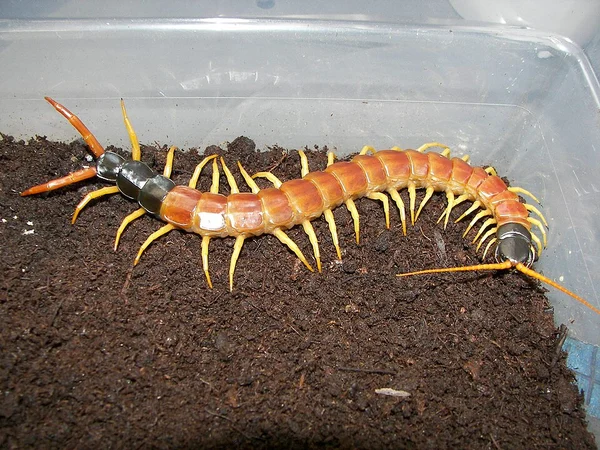
Both groups belong to Phylum Arthropoda, Subphylum Myriapoda (~16,000 living species documented in ITIS and the University of Kentucky Department of Entomology)—meaning they are terrestrial arthropods far more closely related to insects and crustaceans than to earthworms!
Side-by-Side Centipede vs. Millipede Identification Table
| Feature | Centipedes (Class Chilopoda) | Millipedes (Class Diplopoda) |
|---|---|---|
| Legs per Body Ring | 1 pair (2 legs) per single trunk segment |
2 pairs (4 legs) per fused diplosegment (after ring 4) |
| Total Leg Range | 30 to 382 legs (always an odd number of pairs: 15–191) |
34 to 1,306 legs (Eumillipes persephone record) |
| Body Cross-Section | Dorso-ventrally flattened (slips into bark & rock crevices) | Rounded / cylindrical (or dome-backed in flat millipedes) |
| Leg Placement & Speed | Splayed out to the sides; sprints up to 0.4 m/s |
Tucked directly underneath; ripples slowly in metachronal waves |
| Antennae | Long, whip-like, thread-thin (14–100+ segments) |
Short, clubbed / elbowed (7–8 segments tapping soil) |
| Diet | Carnivore (insects, spiders, scorpions, small lizards) | Detritivore (decaying leaf litter, rotting wood, fungi) |
| Primary Defense | Sprints away or pinches with venomous forcipules | Coils into a tight spiral; oozes irritating benzoquinones |
Why Zero Wild Centipedes Have Exactly 100 Legs—and the 1,306-Leg Discovery
Two developmental genetics rules make Subphylum Myriapoda famous among evolutionary biologists:
- The Odd-Pair Law in Centipedes: Developmental studies of
HoxandNotchsegmentation genes show that centipede trunk segments form in pairs after the embryonic stage. Because the very first trunk appendage pair transforms into curved venom claws (forcipules—modified legs, not jaws!), every adult centipede across all3,300+known species ends up with an odd number of walking leg pairs (15pairs =30legs in Scutigera coleoptrata house centipedes;21or23pairs =42or46legs in our20 cmGiant Desert Centipede, Scolopendra heros).50pairs (100legs) is developmental-biologically impossible in wild centipedes! - The First True Millipede (Eumillipes persephone,
2021): For200years, the leg record stood at750legs (Illacme plenipes in California). In December2021, Marek et al. (Scientific Reports, DOI: 10.1038/s41598-021-02447-0) described Eumillipes persephone from60-meter-deep boreholes in Western Australia—an eyeless, thread-thin millipede (95.7 mmlong,0.95 mmwide) sporting330segments and 1,306 legs!
Spotting Myriapods in Guess the Animal Modes
When playing 20 Questions Animal Game or Animal Guessing Game Unlimited, remember that selecting Invertebrates (NO backbone) + Terrestrial (YES) + More than 8 legs (YES) isolates Giant Desert Centipede away from 6-legged insects (Luna Moth, Hercules Beetle) and 8-legged arachnids (Emperor Scorpion, Black Widow Spider) in one clean move!