The quickest way to separate a monkey vs. ape is by checking tails, chest shape, and shoulder mobility: apes (Superfamily Hominoidea—chimpanzees, bonobos, gorillas, orangutans, gibbons, and humans) have no external tail, a broad, flattened ribcage, and mobile ball-and-socket shoulder joints that let their arms rotate overhead to hang and swing; monkeys (Family Cercopithecidae in the Old World and Parvorder Platyrrhini in the Americas) almost always carry a visible tail, have a narrower, deeper chest, and walk primarily on all fours along the tops of branches or open ground.
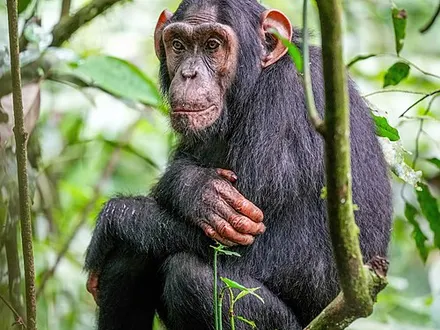
Both groups sit inside Class Mammalia, Order Primates (ITIS TSN 180089), yet anatomical records from Animal Diversity Web and genetic evidence from the Smithsonian Human Origins Program show that apes and Old World monkeys actually share a more recent common ancestor with each other (Parvorder Catarrhini) than Old World monkeys share with New World monkeys!
Side-by-Side Comparison: Apes vs. Old World Monkeys vs. New World Monkeys
| Diagnostic Clue | Apes (Hominidae & Hylobatidae) | Old World Monkeys (Cercopithecidae) | New World Monkeys (Atelidae, Cebidae, Callitrichidae) |
|---|---|---|---|
| ITIS Family TSN | 180090 (Hominidae) / 572775 (Hylobatidae) |
180096 (Cercopithecidae) |
943785 (Atelidae) & allies |
| External Tail | None (0 species); internal fused coccyx |
Present in nearly all (non-prehensile; vestigial in M. sylvanus) | Present in all; prehensile in Atelidae & capuchins |
| Chest & Shoulders | Broad, flat chest; dorsal scapulae; 360° overhead arm swing |
Narrow, deep chest; lateral scapulae; quadrupedal runners | Narrow chest; quadrupedal branch runners & leapers |
| Dental Formula | 2/2, 1/1, 2/2, 3/3 = 32 teeth |
2/2, 1/1, 2/2, 3/3 = 32 teeth |
2/2, 1/1, 3/3, 3/3 = 36 teeth (Atelidae/Cebidae) |
| Lower Molar Pattern | Y-5 bunodont (5 rounded cusps, no cross-ridges) | Bilophodont (4 cusps linked into 2 sharp parallel crests) | Rounded 3-to-4-cusped molars (no bilophodont lophs) |
| Nostril Geometry | Catarrhine: narrow septum, facing downward | Catarrhine: narrow septum, facing downward | Platyrrhine: wide septum, facing outward/sideways |
| Cheek Pouches | Absent in all apes | Present in cercopithecines (baboons, macaques) | Absent |
| Ischial Callosities | Absent in Great Apes; small pads in gibbons | Present (hardened sitting pads on rump) | Absent |
| Native Range | Sub-Saharan Africa & Southeast Asia | Africa, Asia & Gibraltar | Mexico, Central & South America |
| Catalog Mass Span | 5.5 kg (Lar Gibbon) to 160 kg (Western Gorilla) |
7.5 kg (Rhesus Macaque) to 28 kg (Mandrill) |
0.26 kg (Common Marmoset) to 6.5 kg (Howler) |
Why the "Tail Rule" Almost Works—and Its Famous Exception
If you only remember one field shortcut—"monkeys have tails, apes do not"—you will be right over 98% of the time, but one famous Old World monkey breaks the shortcut. The Barbary Macaque (Macaca sylvanus), native to the Atlas Mountains of Morocco and Algeria and introduced to Gibraltar, has a tiny vestigial tail measuring only 1 to 2 cm (per Animal Diversity Web). That nearly invisible tail earned it the misleading English nickname "Barbary ape."
Paleontologists and primatologists never rely on tail length alone to classify a primate. Instead, they inspect three skeletal signatures that never fail:
- Molar Cusps (
Y-5vs. Bilophodont): Every ape—from a5.5 kgLar Gibbon to a160 kgWestern Gorilla—chews fruit and leaves with bunodont Y-5 lower molars featuring five rounded cusps separated by a Y-shaped groove. Every Old World monkey in Family Cercopithecidae—including the tailless Barbary macaque—wears bilophodont molars with two sharp transverse enamel ridges connecting pairs of cusps. - Shoulder Blade Placement: In apes, the shoulder blades (scapulae) lie flat across the back of a wide ribcage rather than along the sides of a narrow torso, freeing the humerus to swing directly overhead for suspensory climbing and brachiation.
- Elbow & Wrist Flexibility: Apes possess an ulnar wrist articulation separated by a cartilage meniscus that permits wide forearm rotation, whereas quadrupedal monkeys retain tighter bone-on-bone wrist stops designed to absorb running impacts along tree limbs.
Great Apes vs. Lesser Apes & Genetic Closeness to Humans
Living apes divide cleanly into two taxonomic families—both represented with real photography and audio in our 365-species catalog:
- Great Apes (Family Hominidae, ITIS TSN 180090): Large-brained, long-lived primates lacking both tails and ischial callosities (per Animal Diversity Web). Our catalog includes the Western Gorilla (Gorilla gorilla,
160 kg,CR, see Smithsonian's National Zoo), Bornean Orangutan (Pongo pygmaeus,75 kg,CR, see Smithsonian's National Zoo), Chimpanzee (Pan troglodytes,52 kg,EN), and Bonobo (Pan paniscus,39 kg,EN). According to the Smithsonian Human Origins Program, single-nucleotide DNA comparisons show only about1.2%difference between humans and chimpanzees or bonobos, and about1.6%between humans and gorillas. - Lesser Apes (Family Hylobatidae, ITIS TSN 572775): Agile Southeast Asian canopy specialists weighing
3.9 to 12.7 kg(per Animal Diversity Web). Though smaller than a Mandrill or Olive Baboon, our5.5 kgLar Gibbon (Hylobates lar,EN) is 100% an ape: zero tail, forearms long enough to swing more than3 metersin a single brachiating stroke (and leap over9 metersbetween branches), and soaring territorial pair duets playable in Guess the Animal Sound.
Old World Monkeys, New World Monkeys & Why Lemurs Are Neither
Monkeys themselves split across the Atlantic Ocean roughly 35 to 40 million years ago into two distinct primate groups:
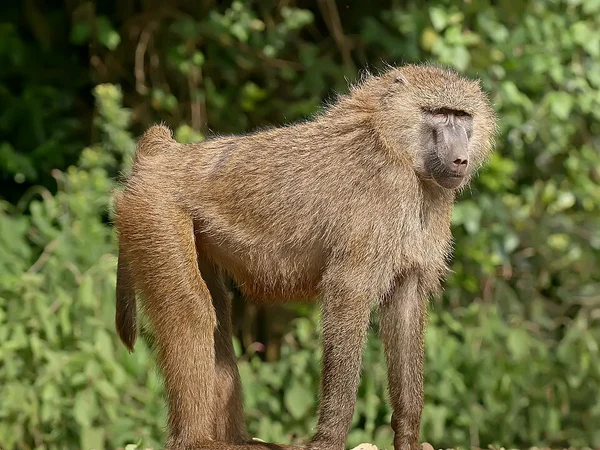
- Old World Monkeys (Family Cercopithecidae, Africa & Asia): Over
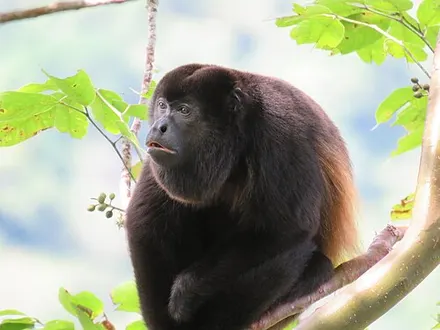
133species across22genera (per Animal Diversity Web). None has a prehensile gripping tail. Our catalog features five iconic members: Mandrill (28 kg,VU), Olive Baboon (20 kg,LC), Proboscis Monkey (18 kg,EN), Japanese Macaque (10 kg,LC), and Rhesus Macaque (7.5 kg,LC). - New World Monkeys (Parvorder Platyrrhini, Americas): Broad, outward-facing nostrils, 36 teeth in Atelidae and Cebidae (one extra premolar per jaw quadrant compared with apes and Old World monkeys, per Animal Diversity Web), and specialized prehensile tails with a bare fingerprint-like grip pad in Atelidae. Playable catalog members include the Mantled Howler Monkey (
6.5 kg,VU), White-Faced Capuchin (3.4 kg,VU), Emperor Tamarin (0.45 kg,LC), and Common Marmoset (0.26 kg,LC). - Prosimian Outgroup (Strepsirrhini): Species such as the Ring-Tailed Lemur (
2.5 kg, Lemuridae), Aye-Aye, and Sunda Slow Loris belong to Order Primates, yet branched off before monkeys and apes evolved—so in biology, a lemur is neither a monkey nor an ape!
How to Decode Primates Fast in Guess The Animal
When Order: Primates lights up in Daily Guess the Animal or 20 Questions Animal Game, you can isolate the exact family in two moves:
- Test Continent Immediately: South America rules out every ape and Old World monkey on Earth, leaving only our four New World monkeys (
0.26 kgCommon Marmoset up to6.5 kgMantled Howler Monkey). Africa or Asia keeps apes, Old World monkeys, and prosimians live. - Use Weight
↑ / ↓& IUCN Status to Split Apes From Monkeys: Every single Great Ape in our catalog weighs39 to 160 kgand carries a threatened IUCN status (EN or CR), whereas all Old World monkeys weigh7.5 to 28 kg. If a mystery primate in Asia weighs5.5 kgand lights up Threatened (EN) without matching Cercopithecidae, lock in the Lar Gibbon (Hylobatidae)!
Sources & Primary References
- Smithsonian National Museum of Natural History — Human Origins: Genetic Evidence
- Smithsonian's National Zoo — Western Lowland Gorilla (Gorilla gorilla)
- Smithsonian's National Zoo — Orangutan (Pongo spp.)
- ITIS Taxonomic Report: Order Primates (TSN 180089)
- ITIS Taxonomic Report: Family Hominidae (Great Apes, TSN 180090)
- ITIS Taxonomic Report: Family Hylobatidae (Gibbons, TSN 572775)
- ITIS Taxonomic Report: Family Cercopithecidae (Old World Monkeys, TSN 180096)
- Animal Diversity Web (University of Michigan) — Family Hominidae (Great Apes)
- Animal Diversity Web (University of Michigan) — Family Hylobatidae (Gibbons & Lesser Apes)
- Animal Diversity Web (University of Michigan) — Family Cercopithecidae (Old World Monkeys)
- Animal Diversity Web (University of Michigan) — Family Atelidae (Prehensile-Tailed New World Monkeys)
- Animal Diversity Web (University of Michigan) — Barbary Macaque (Macaca sylvanus)