You can separate a hawk vs. falcon in seconds by checking wing shape, beak edge, and hunting method: hawks (Order Accipitriformes, ITIS TSN 823961) fly on broad, rounded wings with finger-like primary tips built for soaring on thermals, wear smooth-edged hooked bills, build stick nests, and kill prey with crushing talon strength. Falcons (Order Falconiformes, ITIS TSN 175262) fly on long, narrow, pointed wings built for speed, carry a sharp tomial tooth notch on the upper beak, never build stick nests, and kill prey by biting the neck to sever the spinal cord.
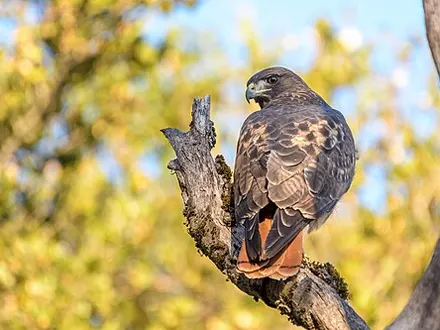
For more than two centuries, naturalists grouped all daytime birds of prey into one single order because both lineages share hooked beaks, forward-facing eyes, and sharp talons. Modern DNA sequencing overturned that assumption completely: falcons are more closely related to parrots and songbirds than to hawks or eagles—making the hawk vs. falcon split one of the most striking examples of convergent evolution in Class Aves.
Side-by-Side Hawk vs. Falcon Field Identification Chart
Every measurement and anatomical trait below is cross-checked against ITIS, the U.S. Fish & Wildlife Service, and the University of Michigan Animal Diversity Web:
| Diagnostic Feature | True Hawks (Order Accipitriformes · Accipitridae) | True Falcons (Order Falconiformes · Falconidae) |
|---|---|---|
| Taxonomic Order (ITIS) | Accipitriformes (TSN 823961) |
Falconiformes (TSN 175262) |
| Closest DNA Relatives | Eagles, kites, harriers, Old World vultures & ospreys | Parrots (Psittaciformes) & songbirds (Passeriformes) |
| Wing Silhouette | Broad, rounded with slotted "fingered" primary tips | Long, narrow, swept-back, sharply pointed tips |
| Flight Pattern | Effortless circling thermal soaring + slow wingbeats | Rapid, stiff rowing flaps, hovering, or 320+ km/h stoops |
| Beak Anatomy | Smooth curved upper edge (no extra tooth notch) | Distinct tomial tooth (triangular notch on upper mandible) |
| Primary Killing Method | Crushing talon grip piercing vital organs | Cervical neck bite using tomial beak after aerial strike |
| Adult Eye Color | Usually yellow, amber, hazel, or red | Almost always very dark brown / black |
| Nest Building | Actively constructs bulky stick nests in trees or cliffs | Builds zero stick nests; uses cliff scrapes, cavities, or old nests |
| Game Catalog Examples | Red-Tailed Hawk (1.1 kg), Bald Eagle (4.8 kg), Golden Eagle (4.6 kg) |
Peregrine Falcon (0.95 kg), American Kestrel (0.12 kg) |
The DNA Phylogenomics Bombshell: Why Falcons Join Parrots
Before DNA sequencing reached whole-genome scale, ornithologists placed hawks, eagles, ospreys, and falcons together inside a single catch-all Order Falconiformes. In 2008, Hackett et al. published a landmark phylogenomic study in Science (DOI: 10.1126/science.1157704) analyzing nuclear DNA across 169 bird species, followed by whole-genome confirmation from Jarvis et al. (2014, Science, DOI: 10.1126/science.1253451).
The genetic family tree shocked birdwatchers worldwide. True hawks, eagles, and kites formed Order Accipitriformes on one major branch of core landbirds (Afroaves), whereas true falcons (Order Falconiformes) sat inside a separate clade (Australaves) right beside seriemas, parrots (Psittaciformes), and perching songbirds (Passeriformes)! In other words, an American Kestrel shares a more recent common ancestor with a Scarlet Macaw or Common Raven than with a Red-Tailed Hawk.
Evolution independently sculpted hooked bills, raptorial toes, and sharp binocular vision in both orders because hunting fast vertebrate prey rewards the exact same engineering solutions. Even subtle details preserved their separate ancestry: per Animal Diversity Web, falcon eggs glow reddish rather than blue-green when held up to light, and falcons molt their primary flight feathers outward starting from primary #4 rather than sequentially from #1 to #10 as hawks do.
Aerodynamics & Beak Physics: Thermal Soarer vs. Aerial Interceptor
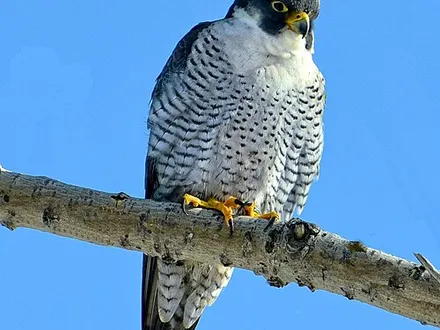
Watch a Red-Tailed Hawk and a Peregrine Falcon hunt over the same valley, and their contrasting anatomy explains every move they make:
- Broad Slotted Wings vs. Swept Delta Wings: According to Animal Diversity Web, a Red-Tailed Hawk (Buteo jamaicensis) weighs
795 to 1,224 g(1.1 kgcatalog average) with a wide122 cmwingspan—females averaging about25%larger than males. Spreading its slotted primary feathers breaks up wingtip vortices, letting the hawk ride rising warm air currents for hours while scanning pastures for voles, rabbits, and snakes. By contrast, a Peregrine Falcon (Falco peregrinus, ~907 gaverage,91–112 cmwingspan, females40–50%heavier than males) packs dense flight muscle onto narrower pointed wings built for straight-line speed. - Diving Beyond
320 km/h: In a 2014 wind-tunnel and field aerodynamics study published in PLOS ONE, Ponitz et al. confirmed that diving Peregrine Falcons exceed320 km/h(200 mph) by tucking their wings progressively from a cupped teardrop silhouette into a swept M-shape that slashes aerodynamic drag while preserving roll control. Small bony tubercles inside falcon nostrils act as airflow baffles so high-pressure air does not burst their lungs mid-stoop. - Tomial Tooth vs. Crushing Talons: Because a Peregrine Falcon strikes pigeons or shorebirds in open sky—where wrestling struggling prey could injure its wings—it immediately bites behind the head with the tomial tooth notch on its upper mandible, cleanly severing the prey's cervical vertebrae (per Animal Diversity Web). Hawks lack a tomial tooth; their thick tarsi and long curved talons clamp shut with ratcheting tendons to crush ground prey before tearing flesh with a smooth curved bill.
Close-Up Clues: American Kestrel, Eagles & Ospreys
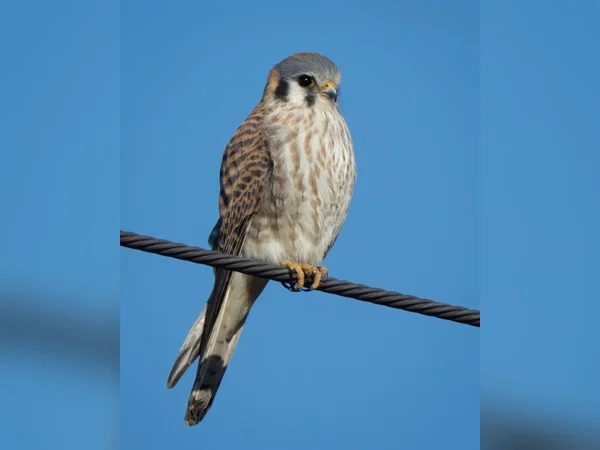
Not every small raptor perched on a highway telephone wire is a hawk—and not every big bird near water is an eagle:
- American Kestrel (Falco sparverius,
0.12 kg,51–61 cmwingspan): North America's smallest true falcon (ADW reports80–165 g), historically nicknamed "sparrow hawk" even though it is 100% a Falconidae falcon! Look for its twin vertical black facial bars, rusty tail, and buoyant wind-hovering hunt over roadside grasshoppers and mice. - Bald Eagle (Haliaeetus leucocephalus,
4.8 kg) & Golden Eagle (Aquila chrysaetos,4.6 kg): Both belong to Order Accipitriformes, Family Accipitridae right alongside the Red-Tailed Hawk—sharing broad soaring wings, huge stick nests, and talon kills, just scaled up to four times the mass. - Osprey (Pandion haliaetus,
1.6 kg): Sits inside Order Accipitriformes in its own specialized fish-hunting family (Family Pandionidae), featuring a reversible outer toe and spiny foot scales for gripping slippery fish.
Using the Hawk vs. Falcon Split in Bird Guessing Game
All six raptors above are playable with verified field photography and authentic vocalizations inside Bird Guessing Game and Guess the Animal Sound:
- Test Order on Turn 1: Submitting Red-Tailed Hawk (
1.1 kg) tests Order Accipitriformes right away. If Class Aves lights green while Order stays dark—and you spot a hooked bill or facial mustache stripe in the darkroom photo—pivot immediately to Order Falconiformes (Peregrine Falcon at0.95 kgor American Kestrel at0.12 kg)! - Use the Weight Arrow Inside Accipitriformes: If Red-Tailed Hawk (
1.1 kg) lights up Order Accipitriformes and shows Weight↑, check Diet and Biome next: Wetland Piscivore points to Osprey (1.6 kg) or Bald Eagle (4.8 kg), whereas Mountain Carnivore points to Golden Eagle (4.6 kg) or Tropical Rainforest Harpy Eagle (7.5 kg). - Listen for the Hollywood Myth: In Guess the Animal Sound, a fierce, raspy, descending keee-eeeee-arr! belongs to the Red-Tailed Hawk, NOT the Bald Eagle (which emits light, squeaky whistling notes). Falcons utter rapid staccato series—the Peregrine's harsh kak-kak-kak or the Kestrel's high killy-killy-killy.
Sources & Primary References
- ITIS Taxonomic Report: Order Accipitriformes (TSN 823961)
- ITIS Taxonomic Report: Order Falconiformes (TSN 175262)
- U.S. Fish & Wildlife Service — Red-tailed Hawk (Buteo jamaicensis)
- U.S. Fish & Wildlife Service — Peregrine Falcon (Falco peregrinus)
- Ponitz et al. (2014), PLOS ONE — Diving-Flight Aerodynamics of a Peregrine Falcon (Falco peregrinus)
- Animal Diversity Web (University of Michigan) — Family Accipitridae (Hawks, Eagles & Kites)
- Animal Diversity Web (University of Michigan) — Family Falconidae (Falcons & Caracaras)
- Animal Diversity Web (University of Michigan) — Red-tailed Hawk (Buteo jamaicensis)
- Animal Diversity Web (University of Michigan) — Peregrine Falcon (Falco peregrinus)
- Animal Diversity Web (University of Michigan) — American Kestrel (Falco sparverius)